---
canonical: "https://www.jsolly.com/blog/Adding-views-likes-to-posts/"
title: "Implementing Anonymous Likes and Views in Django - A Guide"
description: "Learn to implement anonymous likes and views in Django with a step-by-step guide. Discover the best ways to track and record user engagement on your website."
author: "John Solly"
published: "2021-12-31T05:59:46.000Z"
updated: "2021-12-31T05:59:46.000Z"
---
# Implementing Anonymous Likes and Views in Django - A Guide
This was one of the most fun features to implement. I came across a couple Youtube videos on how other's pulled this off. Namely, I stole from one of my favorite Youtubers, [John Elder (Also known as Codemy.com)](https://www.youtube.com/watch?v=PXqRPqDjDgc). He had a good approach, but my beef with his implementation was that he tied it to the user model...meaning that you needed to be logged in to like posts. I wanted an anonymous like button. Did a little more searching and came across Youtuber, codepiep, who made a video about an [anonymous like button](https://www.youtube.com/watch?v=AZwc9hDBi04). I liked his approach too, but I thought his code was quite verbose...plus his Django site was a lot different than mine in that he didn't have the same Post model I was using.
I implemented likes and views in a way that combined both of their approaches. The way it works is that every time someone visits one of my posts, I grab the IP address and throw it into an IP\_Person table. That way, it is 'semi-anonymous' in that I don't know who is viewing and liking my posts (Probably a bunch of bots)...but I can have persistent 'likes' because IP addresses are relatively consistent. Someone cannot keep liking the post over and over to drive the number upward.
Obtsining the client IP is actually pretty straightforward
def get_client_ip(request):
    x_forward_for = request.META.get("HTTP_X_FORWARD_FOR")
    if x_forward_for:
        ip = x_forward_for.split(",")[0]
    else:
        ip = request.META.get("REMOTE_ADDR")
    return ip
There's a OnetoMany relationship between my IP\_Person table and the post\_views and post\_likes tables. A user will only get one record in the IP\_Person table, but they could like or view many posts.
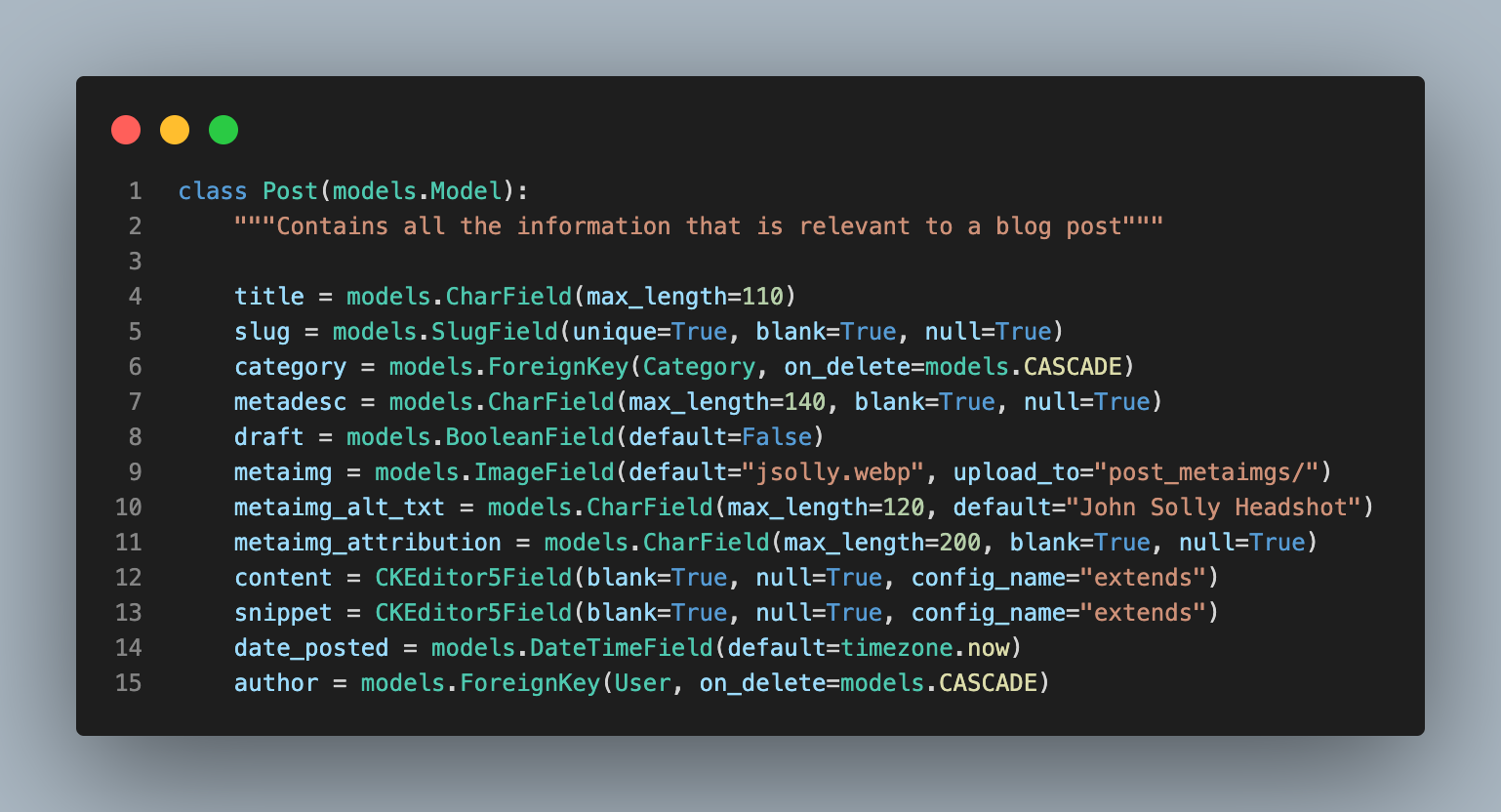
class Post(models.Model):
    title = models.CharField(max_length=100)
    slug = models.SlugField(unique=True, blank=True, null=True)
    content = RichTextUploadingField(blank=True, null=True)
    date_posted = models.DateTimeField(default=timezone.now)
    author = models.ForeignKey(User, on_delete=models.CASCADE)
    category = models.CharField(max_length=100, default='uncategorized')
    -> likes = models.ManyToManyField(IpPerson, related_name="post_likes", blank=True)
    -> views = models.ManyToManyField(IpPerson, related_name="post_views", blank=True)
Quite happy with how it all turned it!
December 31, 2021 in [Web Dev](https://www.jsolly.com/blog/category/web-dev/)
Updated December 31, 2021