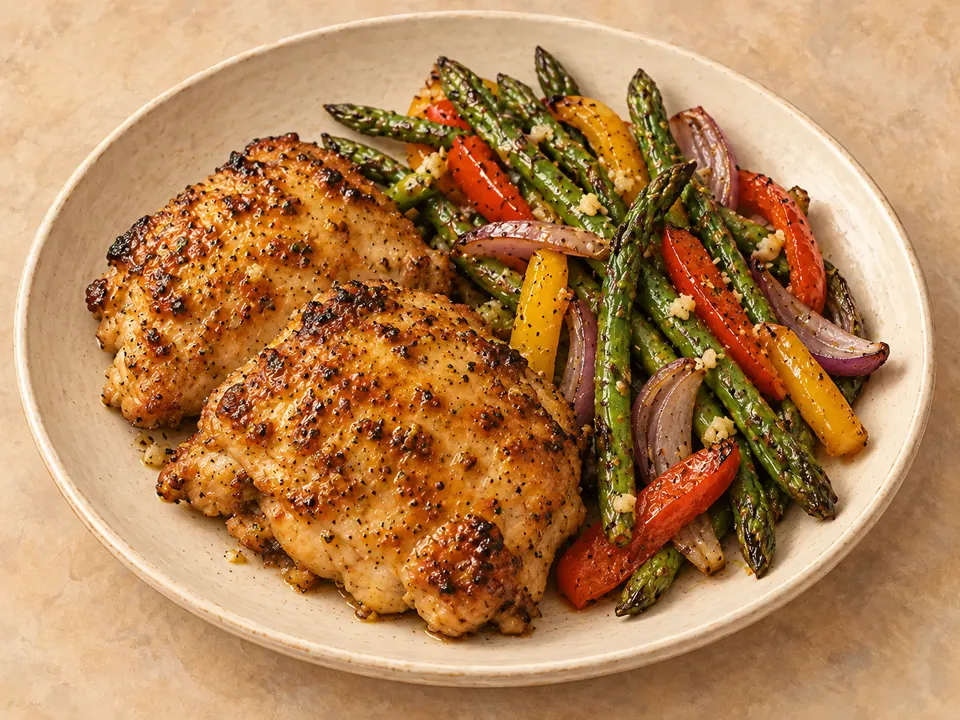
Honey Mustard Chicken Sheet Pan Dinner (keto + low carb)
Keto · 4 servings · US measures · 5 min publisher preparation per four-serving batch
Total time: Not provided
Honey Mustard Chicken Sheet Pan Dinner (keto + low carb). Original recipe adapted with source quantities and workflow.
Follow the cooking flow and check each component at the stated endpoint.
The listed pan and basket capacity, cook times, and thermometer endpoint are for four servings.
Ingredients are scaled; keep food thickness, spacing, settings and safe endpoints fixed. Timings assume the four-serving batch and specified shortcuts. More food can require additional batches.
These recipes include household adaptations and recipes adapted from the linked publishers. The adaptations have not been kitchen-tested. Nutrition provenance and source limitations are listed with each recipe; missing nutrition stays unreported.
Read left to right. Each merged cell acts on the ingredient rows feeding into it. Parallel branches stay separate until plating.
| Heat oven to 425°F. Line a baking sheet. Melt the butter. | ||
| Check poultry or reheated cooked chicken reaches 165°F at the thickest center. | ||
| Coat seasoned chicken with half the mustard. | Roast together at 425°F for 20–25 min to chicken 165°F. Brush with reserved mustard; broil 2–3 min. | |
| Toss vegetables in garlic butter; season to taste. | ||
Ingredients
- 8 count Boneless skinless chicken thighsraw
- ½ cup G Hughes Sugar Free Honey Mustard
- 1 lb asparagustough ends removed
- ½ cup sliced bell pepper
- ¼ cup sliced red onion
- 1 tbsp butter
- 2 tsp minced garlic
- to taste salt and pepper to tasteSource does not state an amount; measure to taste or as needed.
Before you start
- Oven
- Baking sheet
- Mixing bowl
- Instant-read thermometer
Prepare cold sides first. Keep raw-poultry tools separate; use clean serving utensils. Probe more than one thick piece. A timer is not a doneness test.
Cook
- Arrange
Put chicken at one end of the sheet and season it. Coat with half the honey mustard.
- Vegetables
Arrange the asparagus, pepper and onion at the other end. Mix butter with garlic, drizzle over the vegetables and season to taste.
- Roast
Bake 20–25 minutes, until chicken reaches 165°F internally.
- Glaze
Brush chicken with the remaining mustard. Broil 2–3 minutes, watching the glaze closely.
Where your attention goes
Stages can overlap. Do not add every row as separate elapsed time. Safe endpoints and actual appliance behavior override the estimate.
Why this works
Nutrition per serving
Calories: 441 kcal; protein: 51.0 g; total carbs: 7.9 g; fiber: 3.0 g; net carbs: 4.9 g
Publisher estimate per original portion; proportional ingredient scaling preserves that portion.
Listed allergens: milk. Check purchased labels and cross-contact.
First-cook checks
- The publisher lists 20 minutes of cooking, but the method requires 20–25 minutes of roasting plus 2–3 minutes of broiling.
- The source’s per-thigh spoon instructions exceed its listed sauce total; this adaptation divides the listed sauce equally between two coatings.
- Ingredient quantities are scaled from 4 original portions to four portions. Fractions of whole items may need weighing or dividing after preparation. Larger batches need extra cooking space or batches; keep thickness and endpoint checks.
- Adapted from Farmlife DIY. This adaptation has not been kitchen-tested.
- The publisher’s headline time does not cover every step in the method; no complete elapsed-time estimate is reported.
- Safe doneness checks are added to the publisher method; timers alone do not establish doneness.
Leftovers
Refrigerate in shallow containers within two hours, or one hour above 90°F. Use within 3–4 days or freeze; reheat to 165°F. Keep cold greens and yogurt separate.
Sources
- Farmlife DIY: Honey Mustard Chicken Sheet Pan Dinner (keto + low carb)
https://farmlifediy.com/honey-mustard-chicken-sheet-pan-dinner-keto-low-carb/ - FoodSafety.gov: safe minimum internal temperatures
https://www.foodsafety.gov/food-safety-charts/safe-minimum-internal-temperatures
These recipes include household adaptations and recipes adapted from the linked publishers. The adaptations have not been kitchen-tested. Nutrition provenance and source limitations are listed with each recipe; missing nutrition stays unreported.